
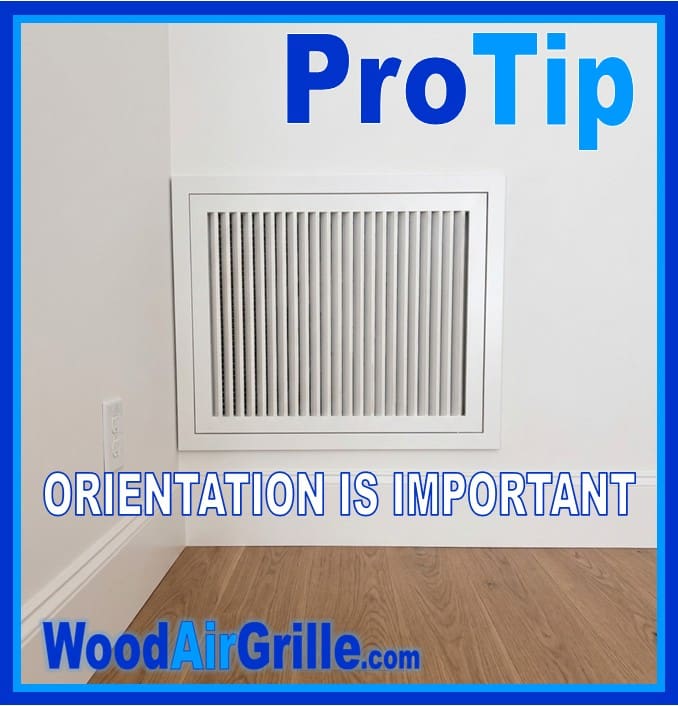
Getting it Right: How to Choose the Correct Orientation for Your Wood Return Air Grille
Upgrading to a custom wood return air grille is one of the easiest ways to elevate your home’s design. But before you add that perfect grille to your cart on WoodAirGrille.com, there is one crucial detail you need to nail down: orientation.
Ordering the right size is only half the battle. Understanding how the grille sits on your wall or ceiling—and which way the louvers point—ensures optimal airflow and keeps ugly ductwork hidden. Here is everything you need to know to select the perfect orientation.
The Golden Rule: Width Always Comes First
In the HVAC and millwork industry, measurements are always listed as Width x Height.
The order of these numbers dictates the orientation of the grille, which can be thought of just like printing a photo:
- Landscape Orientation: A 30" x 20" grille is wider than it is tall. The louvers will run left-to-right along the longer 30" dimension.
- Portrait Orientation: A 20" x 30" grille is taller than it is wide. The louvers will still run left-to-right, but along the shorter 20" dimension.
Mixing up the width and height means your grille will arrive with the louvers running the wrong direction for your wall opening. Always measure the horizontal width of your duct opening first, followed by the vertical height.
Hide the Ductwork: Which Way Should the Louvers Tilt?
The primary visual job of a return air grille is to hide the dark, empty space of the duct behind it. To do this effectively, you need to use your sightlines.
Most louvered grilles are installed so you are looking at the flat surface of the wood slats, not through the gaps.
- Below Eye Level (Baseboards and Low Walls): If your grille is installed low on the wall, the louvers should angle downward toward the floor. Because you are looking down at the grille, angling the louvers down ensures you see the beautiful wood profile instead of the filter.
- Above Eye Level (High Walls): If your grille is installed high up near the ceiling, flip it so the louvers angle upward toward the ceiling. When you look up, your line of sight will hit the bottom of the louvers, keeping the ductwork hidden.
Navigating Ceiling Installations
Ceiling grilles can be a bit trickier since there is no standard "up" or "down." For standard louvered grilles on a ceiling, the best practice is to angle the louvers away from the primary viewing angle. For example, if you walk into a room and look up at the ceiling, the louvers should point away from the doorway so you can't see straight into the duct.
The Egg Crate Alternative
If you are installing a ceiling return and don't want to worry about louver direction at all, egg crate grilles are an excellent option.
Instead of angled slats, egg crate grilles use a straight, intersecting grid pattern. This provides a clean, modern aesthetic and allows for massive, unimpeded airflow. Because the grid looks identical from every angle, it’s a perfect, stress-free solution for central ceiling returns.
Bonus Pro Tip
Sometimes a grille is located where you are going to see through it no matter which way it’s oriented. Painting the plenum box or duct work behind the grille flat black will make it dramatically less noticeable.
Take a few extra minutes to double-check your width, height, and sightlines before ordering, and you'll guarantee a seamless fit for your next project.